
The End Of Confined Space Entry: Why 2026 Is the Year the Oil & Gas Industry Goes 100% Robotic
April 10, 2026How ATEX Zone 0 Robots Are Changing Hazardous Tank Cleaning
June 1, 2026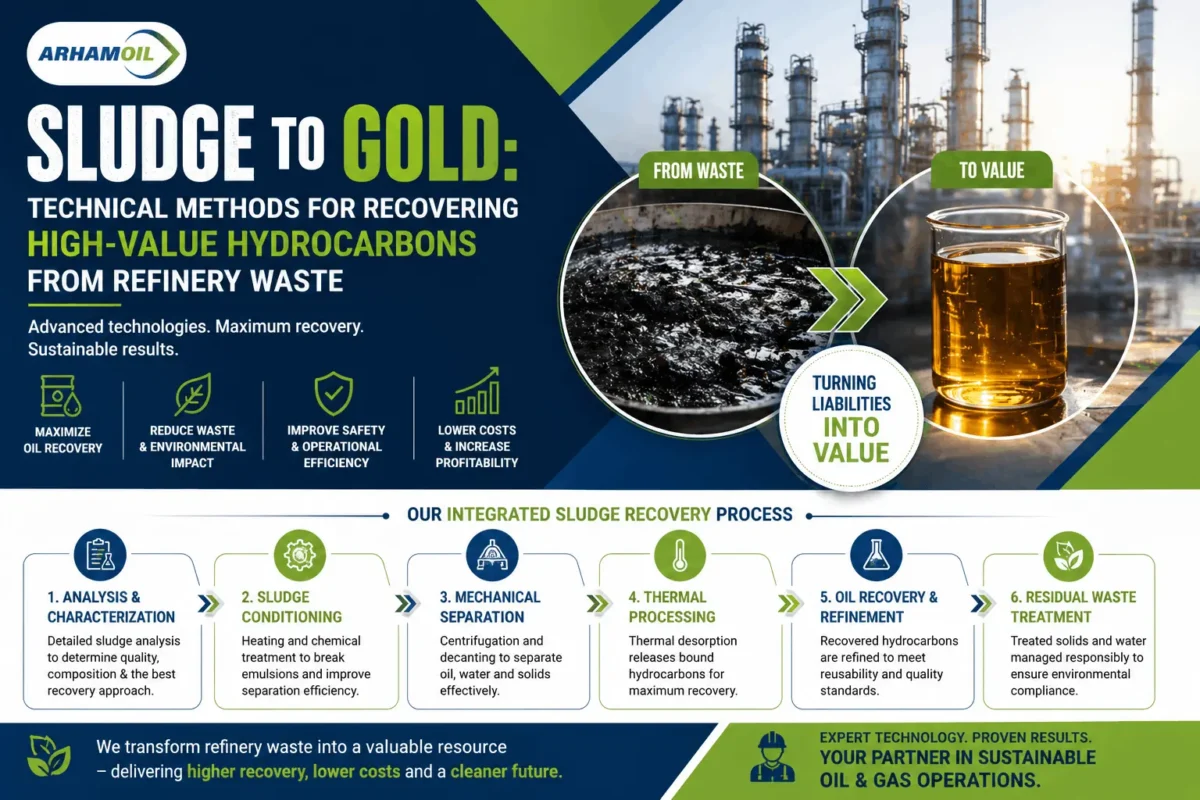
In every refinery and tank storage facility, sludge is an unavoidable byproduct. Over time, crude oil storage tanks, separators, pipelines, and lagoons accumulate thick layers of oily sludge, a complex mixture of hydrocarbons, water, solids, and chemical contaminants. For years, this sludge was treated purely as waste, something to be disposed of at a cost.
Today, that perspective is changing.
Refineries are beginning to recognize that sludge is not just waste, it is a hidden resource. With the right technology and expertise, it can be transformed into valuable hydrocarbons, turning a liability into an asset. This concept, often described as “sludge to gold,” is reshaping how oil and gas companies approach oily sludge processing, oil recovery, and industrial waste management.
As an oil and gas service company, we have seen how advanced sludge treatment solutions can significantly improve both operational efficiency and profitability.
Understanding Oily Sludge in Refinery Operations
Oily sludge forms during routine refining processes, storage tank operations, and oil-water separation activities. It is a dense mixture where hydrocarbons remain trapped within water and solid particles such as rust, sand, and process residues. Depending on the source, sludge may contain anywhere between 20% to 60% recoverable hydrocarbons, making it far more valuable than it appears at first glance.
The real challenge lies in the structure of the sludge itself. The hydrocarbons are often tightly bound within emulsions or embedded in solid matrices, making separation difficult using conventional approaches. If left untreated, sludge gradually reduces storage capacity, increases corrosion risks, and leads to higher operational and disposal costs. Over time, it also creates compliance challenges due to environmental regulations around hazardous waste handling.
Why Sludge Recovery Is Critical for Refineries
Recovering hydrocarbons from sludge is not just a waste management activity; it is a strategic operational decision. Refineries that invest in sludge recovery are able to unlock hidden value from what was previously considered unusable material.
By implementing proper sludge processing systems, facilities can significantly reduce waste disposal volumes while recovering usable oil. This directly lowers operating costs and improves overall plant efficiency. At the same time, it supports environmental compliance by reducing the burden on landfills and minimizing the risk of contamination.
Most importantly, sludge recovery improves tank utilization. Clean tanks can store more product, operate more efficiently, and require less frequent maintenance, creating long-term operational benefits.
Technical Methods for Sludge to Oil Recovery
Recovering high-value hydrocarbons from refinery waste requires a combination of technologies rather than a single approach. Each method addresses a specific challenge in the separation process.
1. Mechanical Separation Techniques
Mechanical separation is usually the first step in sludge processing. It focuses on extracting free oil from the sludge using physical forces. High-speed centrifuges, for example, rotate sludge at extremely high speeds, allowing oil, water, and solids to separate based on density differences. Similarly, decanter systems are used for the continuous processing of large sludge volumes.
While these methods are efficient for recovering easily separable hydrocarbons, they have limitations when dealing with emulsified or chemically bound oil. This is why mechanical separation is often used as part of a broader treatment system rather than a standalone solution.
2. Thermal Treatment and Thermal Desorption
Thermal treatment is one of the most effective methods for recovering hydrocarbons from complex and heavy sludge. In this process, sludge is heated in a controlled environment, causing hydrocarbons to vaporize. These vapors are then captured and condensed back into liquid form, resulting in recoverable oil.
This method is particularly effective for tank bottom sludge, slop oil, and other heavy residues where hydrocarbons are tightly bound. By breaking down the sludge matrix using heat, thermal desorption achieves high recovery efficiency while significantly reducing the volume of residual waste.
3. Chemical Treatment and Emulsion Breaking
In many cases, sludge forms stable emulsions where oil and water are chemically bonded and cannot separate naturally. Chemical treatment plays a crucial role in breaking these emulsions.
Specialized demulsifiers and surfactants are added to the sludge to weaken the bond between oil and water. Once this bond is broken, separation becomes much easier and more efficient. Chemical treatment is typically used alongside mechanical or thermal methods to enhance overall recovery performance.
4. Bioremediation and Eco-Friendly Processing
After most hydrocarbons have been recovered, some residual sludge may still remain. In such cases, biological treatment methods can be applied. Microorganisms are introduced to break down remaining hydrocarbons into less harmful compounds over time.
Although slower than other methods, bioremediation is environmentally friendly and is often used as a final stage to ensure that waste meets environmental standards before disposal.
5. Integrated Sludge Processing Systems
The most effective sludge recovery approach combines multiple technologies into a single, integrated system. Instead of relying on one method, refineries use a sequence of treatments that complement each other.
An integrated system typically begins with sludge conditioning, followed by mechanical separation to remove free oil. Thermal treatment is then used to extract bound hydrocarbons, while chemical additives enhance separation efficiency. Finally, residual waste is treated to meet environmental requirements.
This multi-stage approach ensures maximum oil recovery, minimal waste generation, and consistent compliance with regulatory standards.
Role of Automation and Robotics in Sludge Processing
Modern sludge processing is increasingly driven by automation. Advanced systems now incorporate robotic technologies and real-time monitoring to improve both safety and efficiency.
Robotic sludge removal systems can operate inside tanks without requiring human entry, significantly reducing exposure to hazardous conditions. Automated controls ensure consistent performance, while monitoring systems provide real-time data on process efficiency. This combination of robotics and automation represents the next step in safer and smarter refinery operations.
Environmental and Regulatory Impact
Environmental compliance is no longer optional in refinery operations. Regulations governing hazardous waste management are becoming stricter, and non-compliance can lead to severe penalties.
Advanced sludge processing helps refineries meet these requirements by reducing the volume of hazardous waste and recovering usable hydrocarbons. It also minimizes the risk of soil and groundwater contamination, supporting long-term environmental sustainability.
Economic Value: Turning Waste into Revenue
From a financial perspective, sludge recovery transforms waste management into a value-generating process. Instead of spending on disposal, refineries can recover hydrocarbons that can be reused or sold.
This reduces overall operational costs while improving resource efficiency. In many cases, the recovered oil can offset a significant portion of processing expenses, making sludge treatment a financially viable investment.
Why Expertise Matters in Sludge Processing
Technology alone cannot guarantee successful sludge recovery. The effectiveness of the process depends heavily on proper planning, execution, and operational expertise.
Accurate sludge analysis is essential to determine the right treatment method. Skilled professionals are required to operate equipment safely and efficiently, especially in hazardous environments. Additionally, compliance with safety and environmental standards must be maintained throughout the process.
As an experienced oil and gas service provider, we deliver complete sludge processing solutions from assessment and technology selection to execution and waste management, ensuring optimal results for our clients.
The Future of Sludge Management in Oil & Gas
The industry is steadily moving toward more sustainable and efficient operations. Refineries are focusing on reducing waste, maximizing resource recovery, and adopting automated technologies.
The concept of “sludge to gold” is becoming a standard practice rather than an emerging trend. Companies that invest in advanced sludge processing solutions today are better positioned to meet future challenges and regulatory requirements.
Frequently Asked Questions (FAQs)
1. What is oily sludge in refineries?
Oily sludge is a mixture of hydrocarbons, water, and solid contaminants that accumulates during refining and storage processes.
2. Can valuable oil really be recovered from sludge?
Yes, advanced processing technologies can recover a significant portion of hydrocarbons, making sludge treatment economically beneficial.
3. Which method is best for sludge treatment?
The best method depends on sludge characteristics, but integrated systems combining mechanical, thermal, and chemical processes provide the best results.
4. Is sludge processing environmentally safe?
Modern systems are designed to minimize environmental impact by reducing waste and ensuring proper disposal.
5. How does sludge recovery improve refinery operations?
It enhances efficiency, increases storage capacity, reduces costs, and supports regulatory compliance.
