
Tank Cleaning Robot: Future of Safe and Efficient Tank Maintenance in Oil & Gas
February 28, 2026Sludge to Gold: Technical Methods for Recovering High-Value Hydrocarbons from Refinery Waste
April 20, 2026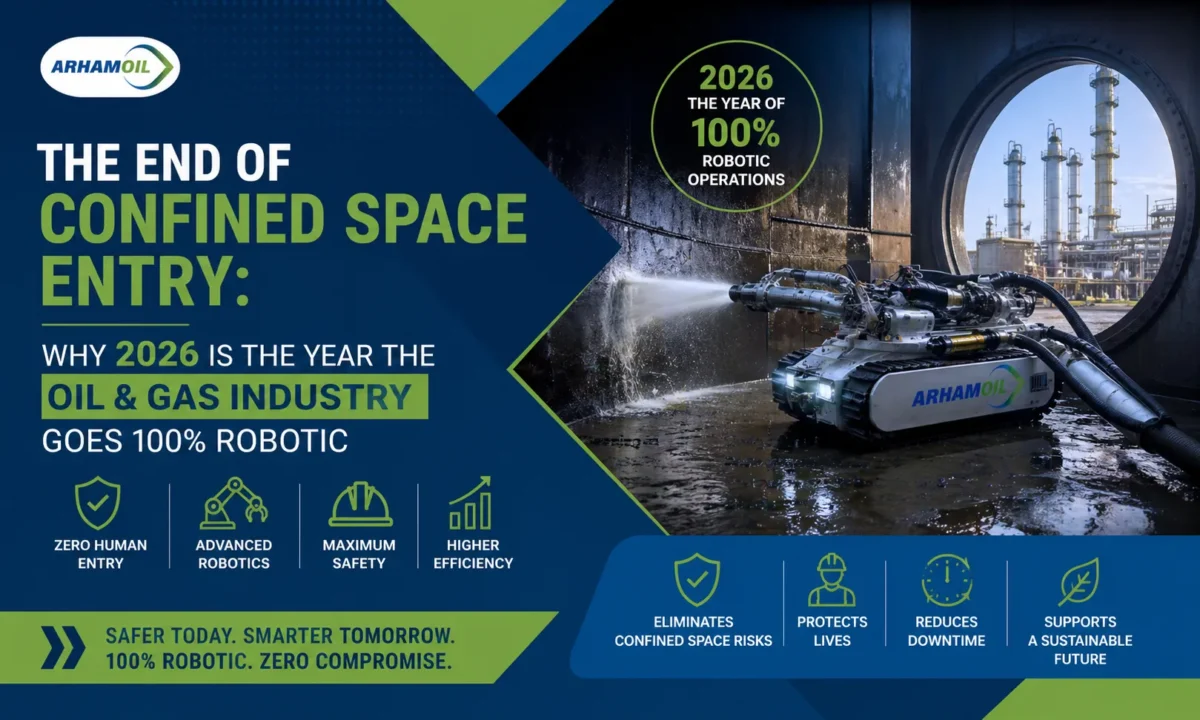
Oil and gas companies for years now have depended on one of their most perilous practices: using human labour inside the confined spaces of their petroleum storage tanks, lagoons, sumps, and pipelines for manual sludge, sediment, and hydrocarbon waste removal. But this practice had become inevitable till now.
With 2026 around the corner, safety regulations are tightening, robotics is proving itself in practical application, and cost benefits make it abundantly clear that zero-incident practices are not just necessary but cost-effective. Refineries, upstream players, and terminals are moving towards eliminating confined space entry around the globe – including India.
Arham Oil has been an industry leader in making this transition happen. Our more than 25+ robotic projects with more than 10,00,000 KL of sludge removal and recovery of more than 4,00,000 KL of oil back into use have made us realise firsthand the benefits of this new methodology.
The Human Cost of Confined Space Entry: A Problem the Industry Can No Longer Ignore
Confined space entry has always been one of the leading causes of fatalities in the oil and gas sector. According to international occupational safety data, CSE-related deaths account for a disproportionate share of on-site industrial fatalities globally. Workers enter tanks filled with toxic hydrogen sulphide (H2S), oxygen-deficient atmospheres, and hydrocarbon vapour conditions that can incapacitate or kill within seconds.
Beyond fatalities, there is the burden of chronic exposure. Workers involved in manual tank cleaning routinely face long-term health effects from benzene, toluene, and other volatile organic compounds. Protective equipment helps, but it cannot eliminate the risk when a human body must physically enter a hazardous environment.
Regulatory bodies like OSHA, India’s OISD (Oil Industry Safety Directorate), and international HSE frameworks have steadily tightened rules around CSE. In 2026, many operators now face mandatory compliance timelines that effectively make traditional manual cleaning either illegal or financially untenable due to liability, insurance, and permitting costs.
The industry had a choice: adapt or continue absorbing the human and financial cost of an outdated practice. The answer is clear.
What Robotic Tank Cleaning Actually Looks Like in 2026?
Modern robotic tank cleaning is not a concept it is a fully deployed service that Arham Oil has been executing across India’s top oil and gas operators, including Indian Oil, Bharat Petroleum, Vedanta, Cairn, Nalco, and HPCL, among others.
This is how a robotic tank cleaning process would appear on site:
- Robotic equipment that uses crawlers is lowered into the storage tank via its manholes – there is no need for manual entry.
- The presence of cameras enables real-time monitoring of activities inside the tank from a distance.
- The robot stirs, dislodges, and moves the deposited sludge located at the bottom of the tank.
- The sludge is removed via an extraction pipe from the tank.
- The removed sludge is then introduced into the sludge processing plant for separation into three phases.
ATEX Zone 0 Robotics: The Technology That Makes It All Possible
One of the most critical enablers of robotic tank cleaning in the petroleum industry is ATEX Zone 0 compliance. For the uninitiated, ATEX Zone 0 refers to areas where explosive gas atmospheres are present continuously or for long periods. This is the classification that applies to the interior of crude oil storage tanks, the most hazardous classification that exists in industrial safety standards.
For years, robotics companies struggled to produce equipment capable of operating inside Zone 0 environments. Standard electronics, motors, and sensors are potential ignition sources. A single spark can trigger a catastrophic explosion.
Today, ATEX Zone 0 Robotics has solved this challenge. Equipment used by companies like Arham Oil is specifically engineered for intrinsically safe operation, meaning all electrical components are designed to prevent the release of sufficient energy to ignite a surrounding explosive atmosphere. Every weld, every seal, every cable fitting meets the ATEX Directive and IECEx certification standards.
Sludge Reprocessing Units: Turning Waste into Revenue
One of the most compelling economic arguments for robotic cleaning is what happens after the sludge comes out of the tank. Traditional manual cleaning methods typically result in large volumes of hazardous waste that must be transported, treated, and disposed of, a significant liability and cost centre.
A modern Sludge Reprocessing Unit changes the equation entirely. Using a combination of thermal desorption, chemical conditioning, and centrifugal separation, these units separate oily sludge into three recoverable fractions:
- Recovered Oil: Typically 40–60% of sludge volume, returned directly to the crude oil stream or sold as recovered product.
- Recovered Water: Treated to acceptable discharge or reuse standards, reducing freshwater consumption.
- Dry Solids: Stabilised for safe, compliant disposal, a fraction of the original waste volume.
Arham Oil’s Sludge Reprocessing Unit technology has recovered over 4,00,000 KL of oil across all projects to date. For context, that is oil that would otherwise have been classified as hazardous waste and sent to incineration or landfill at a high cost. Instead, it became recoverable value, directly improving the economics of each cleaning project.
For oil and gas operators calculating the ROI of switching to robotic methods, the revenue from oil recovery frequently covers a substantial portion, sometimes all of the cleaning project cost.
Online Lagoon Desilting: The Challenge No One Wants to Talk About
If storage tanks are the most visible challenge in O&G waste management, lagoons are the most neglected. Across India’s refinery belts and upstream production sites, thousands of oil-water separation lagoons (OWS), corrugated plate interceptors (CPI), and effluent treatment ponds have been accumulating oily sediment for years, sometimes decades.
Online Lagoon Desilting changes this entirely. Using remotely operated aquatic robots and submersible pump systems, it is now possible to desilt active lagoons while they remain in service without interrupting the effluent treatment cycle.
Arham Oil has executed successful Online Lagoon Desilting projects at facilities where conventional cleaning would have required a full plant shutdown. The results: lagoon capacity restored, separation efficiency improved, and zero personnel exposure to hydrocarbon-contaminated water.
As India’s Pollution Control Boards increase scrutiny on industrial effluent treatment performance, lagoon maintenance is moving from a deferred maintenance item to a compliance priority. Online Lagoon Desilting is the solution that makes compliance achievable without operational disruption.
Frequently Asked Questions:
Q1: What is ATEX Zone 0, and how is it relevant for tank cleaning?
ATEX Zone 0 is the most dangerous environment category due to the presence of flammable gas in the air at all times – such as inside petroleum storage tanks. Certified ATEX Zone 0 Robotics can be safely operated in such atmospheres and represent the sole compliant technology option for non-man-entry tank cleaning.
Q2: How does a Sludge Reprocessing Unit work to separate oil from tank sludge?
Sludge Reprocessing Unit employs heat, conditioning chemicals, and mechanical processing with a centrifuge to separate oily sludge into components – recoverable oil, conditioned effluent and dry residue.
Q3: Can you provide Centrifuge Decanter Rental for short-term jobs or pilot projects?
Yes, definitely – this product would be a perfect choice for customers requiring top-of-the-line separation performance for a limited-scope application without capital investment.
Q4: What is the essence of Online Lagoon Desilting, and how does it differ from conventional lagoon cleaning practices?
Online Lagoon Desilting implies the removal of accumulated sludge from working lagoons through the use of remote-controlled robots without interruption of the process and personnel exposure to it. Contrary to the conventional method that involves complete stoppage of operation, drainage and manual dredging.
Q5: How does Robotic Tank Cleaning compare to manual cleaning in terms of cost?
When oil recovery revenue, reduced manpower, and lower liability costs are factored in, robotic cleaning consistently outperforms manual methods economically. For many Arham Oil clients, recovered oil alone offsets a significant portion of the project cost.
