
Sludge to Gold: Technical Methods for Recovering High-Value Hydrocarbons from Refinery Waste
April 20, 2026Lagoon Desludging: Restoring Capacity and Recovering Value in Oil & Gas Operations
June 24, 2026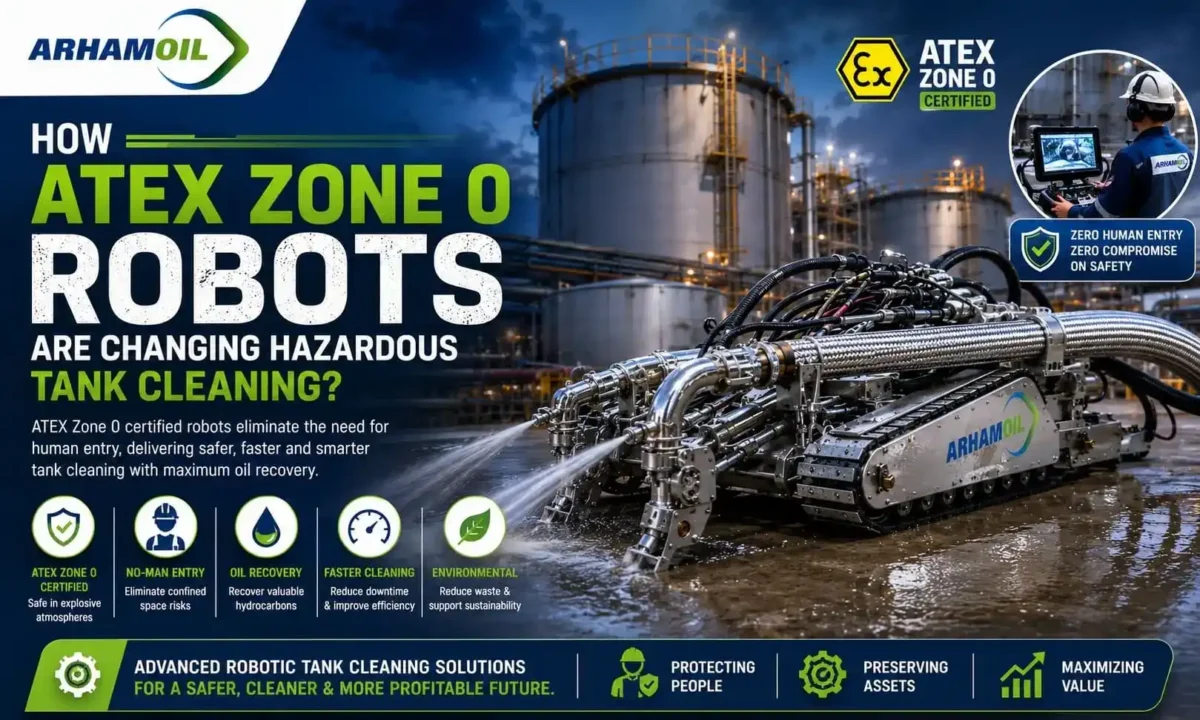
The oil and gas industry has always faced challenges it storage tank maintenance. Crude oil tanks, fuel storage tanks, slop tanks, and refinery process vessels gradually accumulate sludge, sediments, wax deposits, and hydrocarbon residues that must be removed to maintain operational efficiency. Traditionally, cleaning these tanks has been one of the most hazardous tasks in refinery maintenance, requiring workers to enter confined spaces filled with potentially explosive atmospheres, toxic gases, and oxygen-deficient conditions.
Today, the industry is witnessing a major transformation through the adoption of ATEX Zone 0 robots for oil tank cleaning. These advanced robotic systems are redefining hazardous tank cleaning by allowing operators to perform critical maintenance tasks without exposing personnel to dangerous environments. As oil and gas companies continue to prioritize safety, efficiency, and environmental compliance, ATEX Zone 0 robotic technology is rapidly becoming the preferred solution for tank cleaning operations.
Understanding ATEX Zone 0 Environments
To appreciate the significance of ATEX Zone 0 robots, it is important to understand what Zone 0 means. Under ATEX regulations, hazardous areas are classified based on the likelihood of explosive atmospheres.
A Zone 0 environment is the most hazardous classification. It refers to areas where explosive gas atmospheres are present continuously, for long periods, or frequently during normal operations. Inside crude oil storage tanks, product tanks, and hydrocarbon processing vessels, flammable vapors are often present, creating exactly these conditions.
In such environments, even a tiny spark, static discharge, or equipment malfunction can trigger an explosion. This makes conventional cleaning equipment unsuitable and significantly increases risks for personnel working inside the tank.
ATEX Zone 0-certified robots are specifically engineered to operate safely within these explosive atmospheres. Their design eliminates ignition sources and allows maintenance activities to proceed without compromising safety.
Why Traditional Tank Cleaning Presents Significant Risks
For decades, tank cleaning relied heavily on manual labor. Workers entered tanks wearing protective equipment and used cleaning tools to remove sludge and deposits. While safety procedures evolved, the fundamental risks remained.
Personnel entering storage tanks face exposure to:
- Toxic hydrocarbon vapors
- Hydrogen sulfide (H₂S)
- Oxygen-deficient atmospheres
- Flammable gases
- Heat stress and confined space hazards
- Slips, trips, and falls caused by sludge accumulation
Beyond safety concerns, manual cleaning is often slow and labor-intensive. Large tanks may require extended shutdowns, increasing operational costs and reducing productivity.
The introduction of robotic tank cleaning systems has changed this approach entirely by removing personnel from the hazardous zone.
What Are ATEX Zone 0 Tank Cleaning Robots?
ATEX Zone 0 robots are remotely operated robotic systems designed specifically for explosive environments. These robots are certified to function safely in areas where flammable gases are continuously present.
Equipped with specialized motors, explosion-proof components, anti-static materials, and advanced control systems, they can perform cleaning operations inside tanks while operators remain outside in a safe location.
Modern robotic tank cleaning systems are capable of:
- Navigating tank floors and complex geometries
- Breaking down heavy sludge deposits
- Performing high-pressure cleaning
- Supporting sludge recovery operations
- Providing real-time visual monitoring
- Operating continuously for extended periods
Their ability to function safely within active hydrocarbon environments makes them a critical tool for modern refinery maintenance.
How ATEX Zone 0 Robots Transform Hazardous Tank Cleaning
The impact of ATEX Zone 0 robots extends far beyond automation. They fundamentally change how tank cleaning projects are planned and executed.
Instead of preparing personnel for confined space entry, facilities can deploy robotic systems directly into the tank. High-pressure cleaning heads break down sludge while integrated pumping systems transfer the waste for processing and oil recovery.
Operators monitor the entire process through live video feeds and remote control stations. This allows cleaning to be performed with greater precision while maintaining complete visibility of operations.
The result is a safer, faster, and more controlled cleaning process that significantly reduces operational risk.
Enhanced Worker Safety Through No-Man Entry Operations
The most significant benefit of ATEX Zone 0 robots is the elimination of confined space entry during tank cleaning activities.
Traditional methods place workers directly inside hazardous environments. Even with extensive safety precautions, the risk can never be fully eliminated.
Robotic systems remove workers from these dangerous conditions entirely. Personnel remain outside the tank while controlling the robot remotely.
This no-man entry approach reduces exposure to:
- Explosive atmospheres
- Toxic gases
- Hazardous sludge
- Oxygen-deficient environments
For refinery operators focused on achieving world-class safety performance, this represents a major advancement.
Improved Efficiency and Reduced Downtime
Tank cleaning projects often require facility shutdowns. Every additional day spent cleaning a tank affects productivity and profitability.
ATEX Zone 0 robots accelerate the cleaning process through continuous operation and precise sludge removal capabilities.
Unlike manual teams that require frequent breaks, safety checks, and ventilation procedures, robotic systems can maintain consistent performance throughout the project.
Benefits include:
- Faster sludge removal
- Reduced turnaround time
- Quicker tank return to service
- Lower labor requirements
- Improved project predictability
For large crude oil storage facilities, these improvements translate directly into operational savings.
Maximizing Oil Recovery During Cleaning
One of the most overlooked advantages of robotic tank cleaning is its contribution to oil recovery.
Tank sludge often contains significant volumes of recoverable hydrocarbons. During conventional cleaning, much of this material may be treated as waste.
ATEX Zone 0 robotic systems can be integrated with oil recovery and sludge processing technologies. As sludge is removed, recoverable oil is separated and returned for reuse or reprocessing.
This approach helps facilities:
- Recover valuable hydrocarbons
- Reduce waste disposal costs
- Improve sustainability metrics
- Increase overall project value
Instead of simply removing waste, operators can transform sludge into a recoverable resource.
Supporting Environmental Compliance
Environmental regulations are becoming increasingly stringent across the oil and gas industry. Improper handling of tank sludge can result in significant penalties and environmental liabilities.
Robotic cleaning systems provide greater control over waste collection and processing. By minimizing spills, reducing emissions, and supporting hydrocarbon recovery, they help operators achieve compliance with environmental standards.
ATEX Zone 0 robots also support environmentally responsible tank maintenance by reducing waste generation and improving sludge management practices.
Applications Across Oil and Gas Facilities
ATEX Zone 0 robots are suitable for a wide range of industrial applications, including:
- Crude oil storage tanks
- Refinery process tanks
- Slop oil tanks
- Fuel storage terminals
- Petrochemical facilities
- Offshore storage systems
- Hydrocarbon waste tanks
Their versatility allows operators to standardize safe cleaning practices across multiple asset types.
Why Oil and Gas Companies Are Adopting ATEX Zone 0 Technology
The shift toward robotic tank cleaning is driven by a combination of safety, operational, and financial factors.
Companies are increasingly recognizing that relying on manual confined space entry is not sustainable in a modern industrial environment. ATEX Zone 0 robots provide a proven alternative that improves safety while delivering measurable operational benefits.
As digitalization and automation continue to reshape refinery operations, robotic cleaning solutions are becoming an essential part of asset maintenance strategies.
The Future of Hazardous Tank Cleaning
The future of tank cleaning lies in automation, remote operation, and intelligent maintenance systems. ATEX Zone 0 robots represent a significant step toward this future by enabling safe operation in some of the most hazardous environments found in the oil and gas industry.
As technology advances, these systems will become even more capable, integrating artificial intelligence, predictive maintenance capabilities, and advanced inspection tools. The result will be cleaner tanks, safer workplaces, and more efficient operations.
For oil and gas operators seeking to reduce risk, improve efficiency, and maximize asset performance, ATEX Zone 0 robotic tank cleaning is no longer simply an innovation—it is rapidly becoming the industry standard.
FAQs
1. What is an ATEX Zone 0 robot?
An ATEX Zone 0 robot is a specially certified robotic system designed to operate safely in environments where explosive gas atmospheres are continuously present.
2. Why are ATEX Zone 0 robots important for tank cleaning?
They eliminate the need for personnel to enter hazardous tanks, significantly improving safety while maintaining cleaning efficiency.
3. Can ATEX Zone 0 robots recover oil from sludge?
Yes. Many robotic cleaning systems are integrated with sludge recovery and oil separation technologies to maximize hydrocarbon recovery.
4. Are ATEX Zone 0 robots suitable for crude oil storage tanks?
Absolutely. They are widely used in crude oil tanks, refinery tanks, slop tanks, and other hydrocarbon storage facilities.
5. How do ATEX Zone 0 robots reduce downtime?
By operating continuously and removing sludge more efficiently than manual methods, robotic systems shorten cleaning schedules and return tanks to service faster.
